Historic restoration can turn a dilapidated structure into a resplendent tribute to a community’s heritage. And while it may be a labor of love, it is unquestionably a painstaking labor.
On the St. Joseph River in South Bend, developers restoring a historic National Guard armory hoped to preserve as much of its original character as possible in the course of transforming the structure into an elegant community event space.
But in the years since it was built in the 1920s, the red brick building had undergone a few makeovers. Over the decades, it had served as a munitions storage facility and shooting range and a community recreation center and gymnasium, followed by years of disuse. Eventually, the building was targeted for demolition.
Then an agreement between the city and a local developer set the stage for the building’s rehabilitation.
Options for Paint Removal from Old Brick
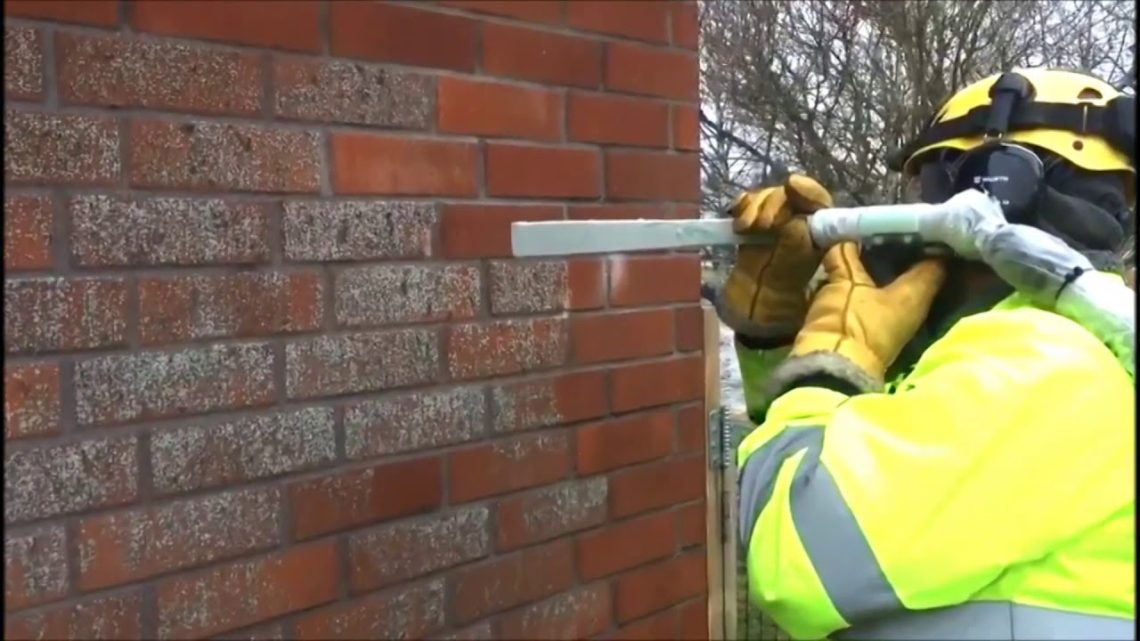
Among other challenges, restoring the building’s exposed brick walls meant removing multiple layers of paint. Paint removal from brick is a common challenge in historic restoration. Brick and mortar can be fragile yet often requires abrasive blasting to remove paint that is multiple layers thick.
The developers brought in a team of industrial blasting experts to conduct validation testing to determine the most effective way to remove the paint without damage the brick or mortar.
Options included:
- Abrasive blasting, which can be performed in wet or dry applications using a variety of media, from corn cobs to garnet, crushed glass, baking soda and aluminum oxide
- Dry ice blasting, a water and chemical-free process that uses frozen CO2 pellets that sublimate on contact, leaves no collateral debris behind and is often used for historic restoration and other delicate applications
- Sponge blasting, a water-free method that uses a variety of media embedded into sponge particles, is especially effective for dust control and can be used in combination with dry ice blasting.
In the case of the former armory, because the paint was so thick, it was determined that abrasive blasting was the best option. While abrasive blasting can havehas the additional disadvantage of introducing water that must be removed afterward, the team brought in to do the work had deep experience with blasting for historic restoration and the effort was a success.
A skilled and careful approach left the building’s interior brick walls restored to full beauty and today the building is an elegant event space and wine bar.
A Twenty-First Century Gathering Space with Historical Integrity
Since reopening in 2018, the building has been the site of weddings, fundraisers and intimate gatherings over local wine and food.
Instead of fluorescent lights shining on paint-spattered walls, chandelier lighting glows off the meticulously restored brick.
Industrial Blasting for Historic Restoration & More
Industrial blasting services are not a one-size fits all proposition, with a wide range of applications that require careful vetting of the options to ensure the best results.
From paint removal for restoration to cleaning food production facilities or petrochemical plants, experienced blasting companies conduct careful testing and assessment to identify the most effective method or combination of methods.